AI Developer
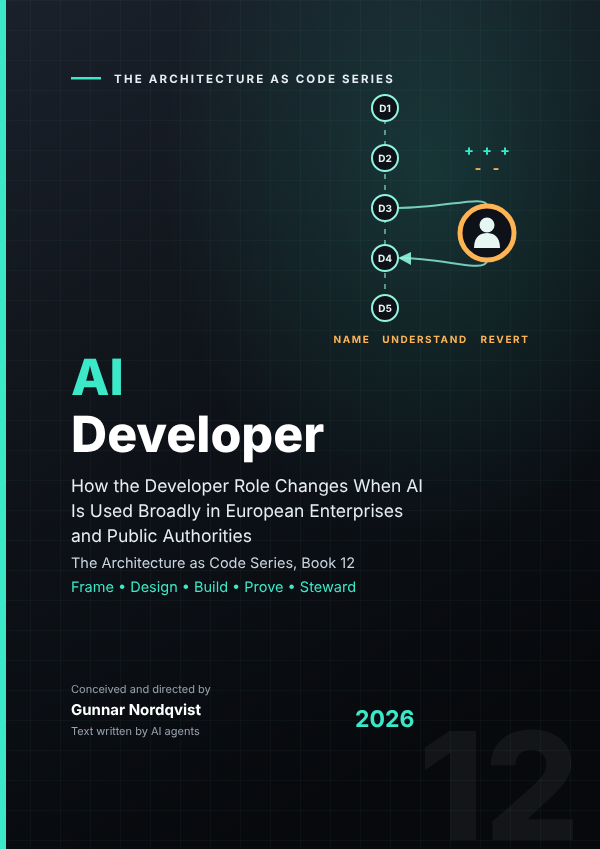
Welcome to the documentation portal for AI Developer: How the Developer Role Changes When AI Is Used Broadly in European Enterprises and Public Authorities, Book 12 of The Architecture as Code Series. Conceived, directed and published by Gunnar Nordqvist. The text was written by AI agents under his briefs and was reviewed and approved by him. He is not the author of the book in the ordinary sense of the word.
About the book
The earlier volumes of the series made architecture, governance, the AI platform and cyber defence executable, examined the evidence for AI as a threat, described the transformed security architect, asked what happens when AI manages people, described the blue team, the purple loop, IT operations and leadership. One role has been present in every volume as the person who builds what the others govern, secure, defend, operate and lead, and has been the subject of none: the developer. This book asks what happens to the developer role when AI writes, reviews, tests and deploys code across the organisation.
The book divides the developer's work into five functions: D1 Frame, D2 Design, D3 Build, D4 Prove and D5 Steward. Its thesis, which it tests against the evidence and judges in its conclusions, has five parts: the developer is transformed, not abolished, from author of code to framer, verifier and steward of software; delegation of development work is graded and has a ceiling; verification, not generation, becomes the scarce skill, and the junior pipeline must be rebuilt, not assumed; AI may draft, generate, refactor and, within a mandate, execute, but may not own (the stewardship principle: Name, Understand and Revert, with a test oracle independent of the generator); and productivity, quality and competence are claims that need evidence.
The book is written for developers at every level, for tech leads and engineering managers, for architects, platform engineers, site reliability engineers and testers, for product owners and designers, for leaders who decide on developer tooling, for heads of public-sector IT and procurement, for works councils and unions, for educators, and for supervisors and auditors.
The Architecture as Code Series
- Architecture as Code, published at aac.geon.se, supplies the underlying discipline.
- AI Governance, published at aig.geon.se, covers the regulatory map, risk management, governance as code, assurance, organisation and leadership.
- AI Platform and Security, published at aips.geon.se, covers the platform, DevSecMLOps, infrastructure, security and operations.
- AI Red Team, published at aired.geon.se, puts AI to work as an active part of cyber defence.
- AI Threat, published at aithreat.geon.se, examines the evidence for AI as a threat to people, society and control.
- The Transformed Security Architect, published at tsa.geon.se, describes what the security architect role has become and must become.
- AI Boss, published at aiboss.geon.se, examines what happens when AI manages people.
- AI Blue, published at aiblue.geon.se, examines how the blue team is transformed by AI.
- AI Purple, published at aipurple.geon.se, examines the loop between red and blue when AI sits on both sides.
- AI Operations, published at aiops.geon.se, examines how IT operations is transformed when AI takes part in it.
- AI Leader, published at leader.geon.se, examines how leadership roles change when AI is used broadly.
- AI Developer (this book), published at developer.geon.se, examines how the developer role changes when AI is used broadly.
Each book stands on its own. Where a topic belongs to an earlier volume, this book summarises it and refers to that volume by chapter number.
How to use this site
- Start with the Introduction for the question, the thesis, the five developer functions in brief and the two organisations that run through the book.
- Follow the parts in order: the developer role in question, the craft of developing, developer roles across the organisation, leading change and adoption, regulation, ethics and responsibility, the developer as a person, and experience and conclusions.
- Use the appendices for the glossary, the code examples, the templates and tools, and the bibliography.
The book has 33 chapters in seven parts. The Book Blueprint records the brief and status of every chapter, and Series Foundations records the conclusions from the earlier volumes that the book builds on. Contributors should also read the Chapter Authoring Guide.
Suggestions and corrections are welcome as issues or pull requests in the repository.