A Year in Development: Nordvik Region and Hansa Mutual
Thirty chapters have built instruments: a loop of five functions, a ladder of delegation, three tests of stewardship and records for specifications, owners, verification, review, agent runs, adoption claims and competence. This chapter uses them for a year. It follows named developers, leads and managers at Nordvik Region and Hansa Mutual from September 2030 to August 2031 and shows where the instruments held, where they did not and what stayed open. It concerns all five functions of the developer loop, D1 Frame, D2 Design, D3 Build, D4 Prove and D5 Steward, because a year does not respect the division of a book into functions.
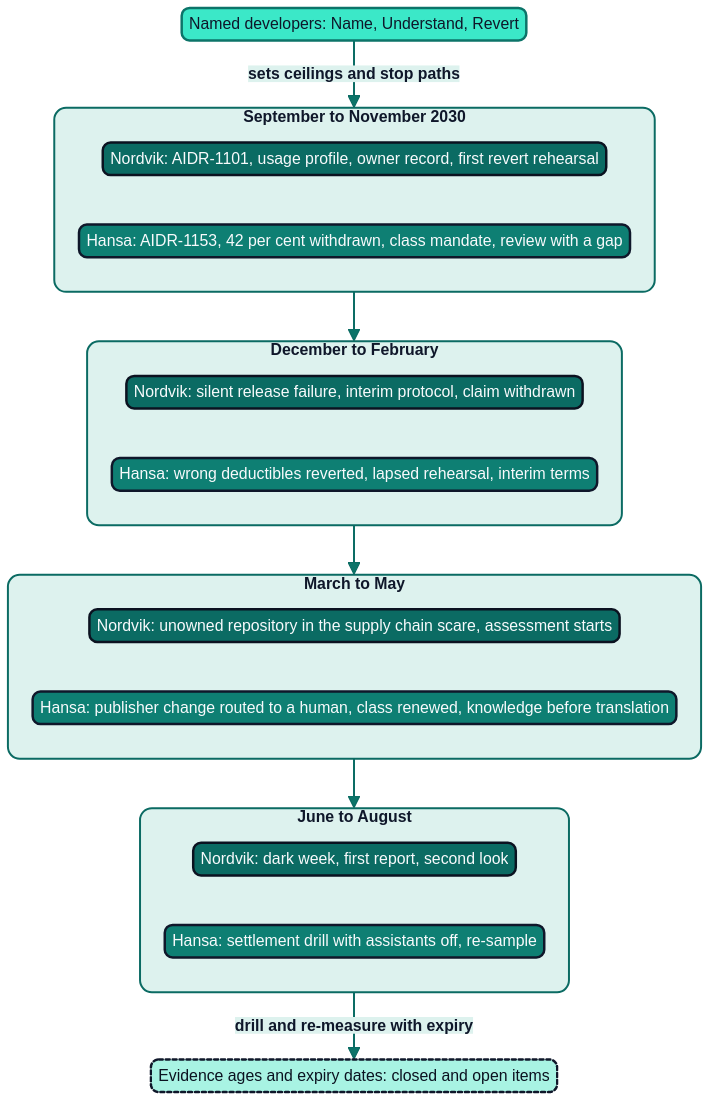
Figure 31.1: The year in development as a timeline of decisions, records and drills at the two organisations.
The people and the rules of the year
The year is illustrative. It is built from the records of Chapters 1 to 30 and from a small number of events that this chapter adds, and it measures nothing. Three kinds of statement appear. Most are recorded: an earlier chapter fixed the date, the identifier or the figure. Some are derived: they follow from a recorded date, such as a rehearsal that passed its own 90-day limit on a day that can be counted. A few are illustrative outcomes, marked "in this illustration", and are new in this chapter. Where an earlier chapter set a date and recorded no outcome, this chapter records none either, because an open item is itself a result. No figure here is a rate, and no sentence is evidence that the instruments work.
There was no go-live in September. Both organisations already ran the tools in the profiles: ambient completion, the Mode 2 assistants NR-DEV-001 and HM-DEV-001, agentic work tools at Mode 3 for a few teams and the test-drafting assistant HM-DEV-002. The first month is the point at which delegation profiles began to bind tools that had been in use for months. The people who carry the story are these.
| Person | Role and organisation | Appears through |
|---|---|---|
| Linnea Sjöberg | Senior developer, case platform team, Nordvik Region (ROLE-NR-DEV-01) |
Dissent in a design record, practice plan, charter, dark week |
| Emil Nordgren | Junior developer, case platform team, Nordvik Region (ROLE-NR-DEV-02) |
First quarter (APR-NR-2030-01) |
| Anders Falk | Tech lead and manager, integration and data team, Nordvik Region (ROLE-NR-TCL-01) |
Pilot note, owner record, release, measurement |
| Saga Edvardsson | Quality engineer, Nordvik Region (ROLE-NR-QA-01) |
The oracle, the post-incident review |
| Maja Lindqvist, Joakim Wester | Platform lead and senior platform engineer, Nordvik Region | Gateway, golden path, stop path, agent-drafted infrastructure code |
| Gunilla Roos | Head of Applications and Integration, Nordvik Region | Accountable for DLG-NR-DEV-01, decisions on owners and migration |
| Ralf Hauser | Senior COBOL and PL/I engineer, Hansa Mutual (ROLE-HM-DEV-01) |
Settlement module, explainer pilot, drill |
| Aylin Demir | Junior developer, claims portal team, Hansa Mutual (ROLE-HM-DEV-02) |
First quarter (APR-HM-2030-01) |
| Stefan Brückner | Tech lead, claims core delivery team, Hansa Mutual (ROLE-HM-TCL-01) |
The 42 per cent figure, agent pilot mandate, incident |
| Ewelina Maj | Test engineer, Polish service centre, Hansa Mutual (ROLE-HM-QA-01) |
Oracle owner, replay of recorded claims |
| Lukas Frey | Head of Hansa Forge, Hansa Mutual (ROLE-HM-PLT-01) |
Gateway, package proxy, stop holder |
| Dr. Philipp Reinhardt | Head of Group Application Development, Hansa Mutual | Accountable for use of DLG-HM-DEV-01 and the mandates |
Around them stand the people who answer for the records: at Nordvik the CIO Henrik Dahl, the HR director Ingrid Halvorsen, regional legal counsel Maria Åkesson and the union's IT representative Tomas Ekblad; at Hansa the group CIO Rainer Lehmann, the chief risk officer Dr. Annette Krämer, the chief HR officer Marlene Voss and Thomas Brandt of the Konzernbetriebsrat. Two earlier volumes ran the same exercise for neighbouring roles: AI Operations, Chapter 29, for operators (170, Nordqvist, 2026), and AI Leader, Chapter 31, for leaders (174, Nordqvist, 2026). Their pattern is tested here against a different role.
September to November 2030: the profiles meet the work
September: ceilings, a commission and two first days
Nordvik's year opened with paperwork that the CIO wrote before the work began. On 16 September Henrik Dahl filed the commission AIDR-1100, endorsed by the regional director, asking Gunilla Roos and Maja Lindqvist to describe the developer role in a Region that uses AI broadly, with Halvorsen, Ekblad and Åkesson as reviewers and a first report due by 30 June 2031. The same day he filed AIDR-1102, the decision that had not been taken in March 2030, when the IDE vendor's update switched on completion of the next line by default; it continued the Mode 2 pilot NR-DEV-001 until 31 December 2030 and no longer. On 23 September DLG-NR-DEV-01 (AIDR-1101) took effect: generate, refactor and test drafts at Level 1 Assisted (the assistant never the oracle for the same change), review, deploy and migrate at Level 0, document at Level 2 Supervised, and the people class not delegated. The profile is a ceiling and not a licence.
Two other things began. The negotiation record MBA-NR-2030-03 on developer tooling and telemetry was opened on 15 September with Tomas Ekblad and Birgitta Almqvist, under sections 11 and 12 of the Swedish co-determination act (10, Swedish Parliament (Sveriges riksdag), 1976). And the executive committee asked whether the roughly 22 consultant developers under framework NR-2025-102 could be cut by a third in the 2031 budget. Roos and Falk answered with a headcount conversation record (Chapter 15): two quarters of team-level measurement of lead time, change failure and rework, and unchanged consultant volume until the budget decision in April 2031.
At Hansa the group CIO's request AIDR-1150 (23 September) asked Dr. Philipp Reinhardt, Lukas Frey and the head of the group AI platform for the same description, with a first report due on 30 April 2031. A week later Rainer Lehmann adopted DLG-HM-DEV-01 (AIDR-1153): generate at Level 2 Supervised outside the security-critical and payment paths and Level 1 inside them, review at Level 1 Assisted (an AI comment never counts as one of the two human approvals), deploy at Level 0, and one Level 3 Bounded class, patch-level dependency updates under MND-HM-DEV-01.
On Monday 2 September the two juniors began their first quarter. Emil Nordgren, who had joined Nordvik in August from the graduate programme, started APR-NR-2030-01 on the case platform team, with Linnea Sjöberg as mentor and Saga Edvardsson as second assessor. Ambient completion was switched off for his learning period, and his first exercise was to trace a defect through the PL/SQL and Java layers without it. Aylin Demir, from Hansa's apprenticeship scheme, began APR-HM-2030-01 in the claims portal team with Jörg Albers as mentor, one working day in five without the assistant by design, and Ewelina Maj as second assessor. Neither plan used coding-tool telemetry on a named person. The reason is empirical as well as ethical. In an experiment with 52 participants learning an unfamiliar library, those who used an assistant scored lower on a quiz of the concepts afterwards, by 4.15 points on a scale of 27, with large differences between patterns of use; the authors' preprint concerns one task and one short session (67, Shen & Tamkin, 2026).
October: the first honest numbers and the first owners
On 7 October Anders Falk, who had run the Nordvik pilot and written the note of April 2030 that said "a third faster", reissued it with a scope, a date and an expiry: 12 of 18 developers, an acceptance rate of 31 per cent from IDE telemetry, a survey answered by nine of the 12 that said "about four hours a week", and delivery time never measured. The usage claim had expired in July and the value claim was asserted, not shown (AVR-NR-2030-01, Chapter 20). In a randomised trial of 16 experienced developers on 246 tasks in their own repositories, developers expected the tools to cut their time by 24 per cent, afterwards believed they had cut it by 20 per cent, and took 19 per cent longer (63, Becker et al., 2025). AVR-NR-2030-01 therefore planned a task-level comparison over six two-week sprints, with no per-person reporting, agreed under MBA-NR-2030-03 before any data were collected.
On 14 October Stefan Brückner at Hansa withdrew the 42 per cent figure from his team's reporting, the day the claims core delivery team adopted its working agreement. The figure counted accepted suggestions as a share of committed lines, came from IDE telemetry in February 2030 and had reached the executive board; a sample of 40 merged pull requests in August 2030 found 27 per cent of lines traceable to an accepted suggestion and no measure of whether they stayed (AVR-HM-2030-01, Chapter 20). The same day the negotiation of KBV-IT-2024-DEV-01 opened.
Ownership came next. The inventory of July 2030 had found that 31 per cent of Nordvik's 96 repositories named an owner who had left the Region or changed team (OWN-NR-2030-00). On 14 October Gunilla Roos decided in AIDR-1112 that every repository would have a named owner and deputy by the end of December or be proposed for archive, and that the EUR 1.2 million modernisation assessment would wait for extended regression packs. The same day Falk became the owner of portal-register-adapter (OWN-NR-2030-04, Chapter 12), whose revert had been tested on 9 October.
On 21 October Falk decided ADR-NR-0031, the case-status interface behind the gateway, with NR-DEV-001 at Level 0 Advisory proposing options. Sjöberg's dissent is on the record: the stored-procedure transitions of the case system are undocumented, and an interface that mirrors them mirrors what nobody can explain. At Hansa the architecture forum accepted the payment-instruction interface as the only path from the claims core into SVC-HM-004, and rejected a plan in which a Mode 3 agent called the settlement module directly, citing INC-HM-2029-0207 (Chapter 6). That day Hansa merged the change the year would remember: CHG-HM-2030-0412, the calculation of deductibles and caps for property claims in SVC-HM-001, produced by an agent under MND-HM-DEV-02 in run RUN-HM-2030-0188. The oracle was Ewelina Maj's and independent of the agent: 36 expert cases, properties taken from the policy wording and a replay of 12,400 recorded claims (VER-HM-2030-0007). Two developers reviewed for 55 and 20 minutes, the replay showed 17 differences, all explained, and the mutation score was 0.83. The record said what it did not cover: partial-loss claims with two deductibles, listed as FND-HM-2030-0021 with no owner and no date (RVW-HM-2030-0412, Chapter 9). It was an honest review with one small omission, and the omission would matter by December.
November: gates, a rehearsal and a first quarter's end
On 4 November Nordvik rehearsed the revert of CHG-NR-2030-0212, a timeout and circuit breaker in the register gateway client of the portal, in nine minutes against a target of 15, and a seeded fault was caught by the oracle that Saga Edvardsson's quality function owned (VER-NR-2030-0011). On 7 November the change went out in the weekly portal release in rings of 5, 50 and 100 per cent. The assistant NR-DEV-001 had written 38 of its 61 changed lines. The gate sat in the repository region-policy, owned by the platform lead and the CISO's office, and neither the author nor the assistant could edit it (Chapter 11). Falk was named, explained the change with the assistant off, and the revert had a rehearsal date. Hansa did the same on 12 November for a class-approved update of a logging library in SVC-HM-005 (CHG-HM-2030-0415), whose revert rehearsal was then 41 days old.
The two practice plans of Chapter 28 began in these weeks, Sjöberg's on 4 November (three hours a week without the assistant, two of code reading, a fortnightly pair kata with Nordgren) and Albers' on 11 November, both as interim arrangements pending the works agreements (AIDR-1137 and AIDR-1187). On 18 November the platform team ran its first agent task under a mandate: Lindqvist requested a change to a log-retention setting in the Spring golden path, the agent drafted it, Joakim Wester reviewed it for 22 minutes, and the agent had also edited a README outside the task, which Wester reverted (RUN-NR-2030-0019). The sandbox host wrote the run record, not the agent, and prompts were not retained pending the negotiation. The agent ran under MND-NR-DEV-01 at Level 1 Assisted, the level at which the mandate started. The same day AIDR-1116 decided that the pilot could continue after 31 December only through the Region's AI gateway, which records metadata and no prompt content, and set the platform team's drafting of infrastructure code at Level 2 Supervised from that date.
On Friday 29 November the first quarter of the juniors ended. Demir had read the specification of her first change, the shorter claims notification form (SPC-HM-2030-0001), before any code was generated, and her competence record stood at Foundation level (CMP-HM-2030-DEV-02). In this illustration Nordgren's plan met two of its four milestones on the date and two a fortnight later, and from 2 December his completion was switched on for work outside the inherited modules.
December 2030 to February 2031: two quiet failures, a lapse and an agreement
December: what neither pipeline could see
The month brought the two incidents of Chapter 23, which are alike where it matters. On 2 December Nordvik released an option in the home-care application form that let an applicant ask for help completing it (CHG-NR-2030-0091). The case-platform interface silently ignored the flag, because the requirement that it accept the flag had been an assumption with no acceptance criterion. Fifty-three applicants were not called for ten days, until one telephoned on 12 December (INC-NR-2030-0094). Roos was incident commander, the option was switched off by feature flag 22 minutes after the decision, all 53 were called by 15 December, and counsel Maria Åkesson assessed that no personal data breach was engaged. Edvardsson facilitated the review (PIR-NR-2030-0006): a specification gap, with the Understand test failed for the interface mapping. Prompts were not recorded, so the review could neither attribute the gap to the assistant nor rule it out.
At Hansa, on 4 December, INC-HM-2030-0364 was raised: CHG-HM-2030-0412 had paid 31 claims with the wrong deductible, 19 too high and 12 too low, in precisely the partial-loss case that FND-HM-2030-0021 had listed as not covered. The change was reverted by feature flag and pipeline rollback in 38 minutes, Brückner as steward passed Name, Understand and Revert, and the incident was classified as not major under DORA (2, European Union, 2022). The review had been honest; the finding had no owner, and a gap without an owner is a gap nobody closes. Two rules followed within a fortnight: Roos's AIDR-1123 (16 December), that a requirement recorded as an assumption needs an acceptance criterion, or an owner and a date, before release, and Reinhardt's AIDR-1173 (18 December), that a "not covered" entry in a review record needs a finding with an owner and a due date before the merge. They are one rule. Both failures were quiet in the sense Richard Cook gives the word: no single error, several gaps that lined up (75, Cook, 2000).
On 12 December Nordvik and the union signed an interim protocol under MBA-NR-2030-03, valid to 30 June 2031 (recorded in AIDR-1122 of 9 December), which let the pilot continue beyond 31 December through the gateway and made any widening beyond the 12 developers wait for the review of the record. At Hansa the negotiation of KBV-IT-2024-DEV-01 was in its second month; the claims core team's own agreement (AIDR-1171, 9 December) said meanwhile that the AI-assisted share is not a target, is never shown with a developer's name, and that acceptance rates never enter appraisal or pay.
The Nordvik pilot claim closed, in this illustration, on Friday 20 December. Regional controlling, the evidence owner, filed the six-sprint comparison and Roos signed it, which satisfied the stop rule of AVR-NR-2030-01 together with the protocol. With 12 developers and six sprints the comparison could have shown a large effect and did not; the interval for lead time included a saving and a cost. Falk's note withdrew "a third faster", said what was measured and over which sprints, and said that the Region did not know and by when it would know more.
One expiry was derived. The revert rehearsal behind the class approval of MND-HM-DEV-01 had been run on 2 October, 41 days before the 12 November change, and by the 90-day rule of Chapter 11 it lapsed on 31 December. From 1 January the Level 3 Bounded class fell to Level 2 Supervised without anyone deciding it.
January and February: a lapse repaired, a charter, a failed exit
On 8 January, in this illustration, Hansa Forge repeated the rehearsal and the class returned to Level 3 Bounded; for a week the pipeline had asked a person to approve what it was otherwise allowed to merge (RST-HM-2031-0001). The mandate review of MND-HM-DEV-02 was due on 7 January and the next stop-path drill on 12 January; the book records no outcome for either. The same day the Nordvik revert rehearsal of 4 November, which would have lapsed on 2 February, was repeated in 11 minutes, in this illustration (AIDR-1111 rehearsal of 8 January). On 22 January, in this illustration, the negotiation agreed the use-of-tool statement and left the retention of prompts for incident analysis and the position of the consultants open.
On 27 January Lehmann recorded two decisions that belong together. AIDR-1172 applied interim terms to all group companies pending signature of KBV-IT-2024-DEV-01: no report by named developer, no acceptance rates in appraisal or pay, licences of HM-DEV-001 not extended beyond 340, the agent pilot not widened; Marlene Voss held the dialogue with Thomas Brandt. AIDR-1176 recorded the exit plan EXIT-005 for the IDE assistant, whose test on 19 January had passed its gate at 0.91 against 0.90 on 150 tasks, with an age limit on the evidence. Sjöberg's practice plan (Chapter 28, AIDR-1137) produced its work sample on 24 January, an unaided explanation of how the case system decides a status transition.
On 1 February ROLE-NR-DEV-01 came into force for Sjöberg (AIDR-1114), with a review budget, a first judgement before the assistant's comment on one review in five and holds answered within three working days. On 3 February the Nordvik exit test for the self-hosted coding model failed its gate, 0.86 against 0.90 on 120 tasks (RST-NR-2031-0001); the CIO's record of 10 February (AIDR-1126) reported it as failed, dated the retest and named the shared failure domain behind the serving capacity, the identity federation at the national shared-service provider. On 3 February Hansa's AIDR-1174 treated the mobile claims app and the broker plug-in as within the Cyber Resilience Act until counsel concluded otherwise (242, European Union, 2024), named Reinhardt as holder of the manufacturer's duties and added a CRA clock to the case record. The anti-pattern check of Chapter 30 was run at Nordvik (AIDR-1130) and on 17 February at Hansa (AIDR-1180); at Hansa the acceptance-rate dashboard was remedied and three patterns stayed open: the unowned agent for 14 services and the COBOL estate, the junior hole in the broker interface team and a prototype found outside the low-code platform. A developer in Brückner's team, asked to rank broker-plug-in enquiries by a derived "likelihood of claim" partly on postcode, raised it; the record held it and routed it to the chief risk officer's delegate (Chapter 25).
March to May 2031: a supply-chain scare and a decision about legacy
March: a name that existed
The scare of the year was a near miss, and its shape is the one Chapter 30 calls the trusted name. It is illustrative, and the library is fictional. On Tuesday 4 March the registry's maintainers published an advisory: release 5.1.6 of json-schema-check, a library both organisations used, had been published from an account other than that of its long-standing maintainers, and was withdrawn three days later. The advisory concerned a release and not a name. A control against package hallucination, such as the proxy rule that had refused three non-existent names to Hansa (FND-HM-2030-0012), tests whether a name exists; this name existed and had been in the group's bill of materials for a year. A real advisory of the same class is on the record: in August 2025 malicious versions of a widely used build tool were published and carried a post-install script that collected credentials from the machines that ran it (31, Nx project (nrwl), 2025).
At Hansa the dependency bot proposed 5.1.6 for two repositories. The Level 3 class did its work in two places: the proxy held the release because it was younger than the minimum age, and the class's route to a human fired on a change of publisher. Daniel Fischer in Hansa Forge read the proposal and rejected it. The finding record (FND-HM-2031-0004) asked which services contained 5.1.4 or 5.1.5, which 5.1.6 and which builds had fetched it, and answered from provenance records. For SVC-HM-005 the answer took 40 minutes, following the build-provenance pattern of the SLSA specification (231, OpenSSF, n.d.); for the mainframe batch it was "not asserted", the Mode 0 blind spot of Chapter 10. No build of the mobile claims app had contained the release, so on the group's reading no 24-hour early warning under Article 14 of the Cyber Resilience Act was due, and the case record said why instead of staying empty. NIS 2 lists supply-chain security among the required measures (Article 21(2)(d)) (3, European Union, 2022), and this record is the kind of evidence a supervisor would ask for.
At Nordvik the golden paths pin versions in lockfiles, so the two portal repositories fetched nothing. The proxy has no minimum age, and its log showed that three repositories had pulled 5.1.6 in the three days. Two were pinned and had pulled it into a branch build only. The third was an older utility repository whose owner had left in 2029, which had resolved a version range into a CI build. It was one of the 31 per cent; under AIDR-1112 it had been proposed for archive in December and was waiting for the archivist's agreement. The artefact was not deployed, the cached copy was deleted and the CI credentials of that build were rotated. The scare cost a day and one rotation, and showed what an ownership gap is: a build nobody was responsible for read the internet on a schedule.
Two other dates fell in March. On 12 March, three days before its due date, the retest of the Nordvik exit route (RST-NR-2031-0002) failed its gate again, at 0.88 against 0.90, in this illustration; the exit stood as a stated route and not as a claim that the team could leave without loss. On Friday 21 March, two days before its due date, the review of DLG-NR-DEV-01 (AIDR-1135) kept every ceiling and confirmed the intake of two juniors for 2031, independent of the tender. Counsel's confirmation of the Region's position on open-source stewardship, due on 31 March (Chapter 24), passed with no outcome recorded. Hansa's review of DLG-HM-DEV-01 followed on Friday 28 March (AIDR-1185). The class approval ran until 30 March; the review renewed it for six months, with a longer waiting period before a new release becomes eligible, the lesson of the scare, and left the conditions on publisher change, new transitive dependencies, licence change and failed checks as they were. The head of the broker interface team, who had taken no apprentices in 2030 on the strength of the 42 per cent figure, reviewed that decision the same day and, in this illustration, reversed it and took two apprentices for the 2031 intake.
April and May: reports, a budget and the old systems
Hansa filed its first report under AIDR-1150 on 28 April, two days early, with the horizon register HZN-HM-2031-01 approved on 22 April (AIDR-1179). It carried the profile, the ages of its claims, the open items of the anti-pattern check and three trends, among them five of twelve COBOL and PL/I maintainers within eight years of retirement (observable, Chapter 29). On the adoption claim it said: 42 per cent withdrawn, 27 per cent verified for one sample, persistence and value not measured.
Nordvik's budget decision came in April. The executive committee had asked in September whether consultant volume could be cut by a third. With two quarters of team-level measures in front of it and the pilot claim withdrawn, it decided, in this illustration, to keep the volume of NR-2025-102 unchanged for 2031 and to decide the 2032 budget on four quarters. The decision did not say that the tools had helped or not; it said that the Region had no measure that could carry a headcount decision, and it set a date.
The legacy question was decided in May, and the two decisions follow the sequence of Chapter 12: owner first, oracle second, knowledge third, translation last. On 12 May Reinhardt took AIDR-1186 for the policy administration platform behind SVC-HM-003. No tool-assisted translation of any COBOL or PL/I module would start until Ewelina Maj's replay oracle covered the quarter-end settlement run. The explainer HM-DEV-003 stayed at Level 0 Advisory with its four users, among them Ralf Hauser. The recorded conversations with senior engineers continued under the Betriebsrat terms (in this illustration two of the three targeted for December had been recorded by then, the third in February), and the apprentices of the 2031 intake would follow a reading route in the estate before they were allowed to ask the explainer. The listing of the estate by named owner and deputy (OWN-HM-2030-07) is recorded for the settlement module only.
Nordvik decided on Monday 19 May (AIDR-1136), after Roos reported that the regression packs of the benefits workflow and the portal had been extended to three registry systems, to start the modernisation assessment on those three and not on the social-services register Socialia, whose 600,000 lines of stored procedures have no pack. Sjöberg's recorded reasons for the customisations of SVC-NR-003 were the input, before any assistant was asked to summarise the code, and migrate stayed at Level 0 Advisory. The decision made no claim that the other six inherited systems were understood. The horizon register HZN-NR-2031-01 was approved on 12 May (AIDR-1129).
June to August 2031: drills with the tools off, and a second look
June: the dark week and the settlement drill
A drill with the tools off tests whether a team can still do what it says it can do. For developers it has three parts: the named owner explains the change with the assistant off (Understand), the change can be taken back by a route that does not go through the pipeline that shipped it (Revert), and the person who can switch the tool off is not the person who sponsors it, so that the stop path lies outside the system it stops (Chapter 8).
Nordvik ran a dark week from 16 to 20 June in the integration and data team and on the platform side. Lindqvist, whose team does not report to the sponsor Roos, switched off the gateway route to NR-DEV-001, and the platform team enforced the IDE policy that disables ambient completion, which had been tested on 27 January. In this illustration four changes were merged in the week, each owner explained their change without the assistant, and one explanation needed the ADR and a second reader. The revert test was the one that mattered. On Thursday 19 June the weekly portal release was taken back by a manual route outside the pipeline, with the GitOps controller paused, in 34 minutes against 30 agreed (RST-NR-2031-0003). The delay had one cause: the only manual route depended on credentials issued through the identity federation at the shared-service provider, the failure domain that the dependency record of February had named. The finding went to Lindqvist with a date, two local break-glass accounts held by two named engineers and tested by 30 September, and was open at the end of the year. On 17 June the interim protocol was extended, in this illustration, to 31 December 2031 by an exchange of letters with Ekblad, with prompt retention and the consultants still open. The first report under AIDR-1100 was filed on 27 June, three days early.
Hansa's drill was held on Thursday 26 June, four days before the quarter-end settlement run. A change to the settlement module behind SVC-HM-004 was prepared and reviewed with every assistant and agent switched off by Lukas Frey at the gateway, a switch in Hansa Forge that the pilot's sponsor does not control. The second approver came from outside Policy Systems, as AIDR-1161 and AIDR-1162 require, and Ewelina Maj's replay oracle ran against the recorded settlement runs (RST-HM-2031-0004). Ralf Hauser explained the module's quarter-end path unaided and, in this illustration, could not explain a 1998 exception table in the same module without the recorded conversation. The drill could not switch off one tool, the managed service provider's own code assistance for the mainframe batch, and the record says so instead of recording the switch-off as complete. The revert of the test change passed. The three findings were the exception table, the unswitchable tool and the 90 minutes that the second approver needed to read a change the author wrote in 20; each went with a date to its owner.
July and August: the second look at the numbers
The July reviews of the duty registers (21 and 28 July) and of EXIT-005 (19 July) leave only their dates in this book.
At Nordvik regional controlling restated AVR-NR-2030-01 in a third revision on 12 August, with Falk as claim owner and the gateway's metadata at team grain as the usage source. In this illustration the lead time, the change failure rate and the rework rate of the case platform and integration team lay inside the variation of the preceding year, and the record stated that this does not exclude a small effect in either direction. The usage claim carried a 90-day expiry, to 10 November, and the value claim 180 days. The record does not say the assistant helps or does not. It says that the Region did not let a number it could not defend reach a budget.
At Hansa the sample of merged pull requests was drawn again on 26 August: 40 pull requests, with traceability of lines to accepted suggestions and, for the first time, the persistence after twelve months of the lines of the 2030 sample. In this illustration the share traceable to accepted suggestions was within five percentage points of the first sample, and the persistence difference between suggestion-derived and hand-written lines was smaller than the sample could resolve. The record asked for a larger sample before any statement about quality, and carried forward the security comparison that Chapter 10 planned and that had not been run. In both organisations a number carries its method, its date and its expiry.
What the year showed
The year is a set of records, and the records can be counted. The ledger below is Nordvik's, as it stood on 31 August 2031.
# year/read-out-nordvik-2031-08.yaml (illustrative)
kind: year-read-out
holder: {role: head of Applications and Integration, name: Gunilla Roos}
partner: Ingrid Halvorsen          # holds the ledger; does not read coding-tool logs
period: 2030-09-01/2031-08-31
commission: AIDR-1100
entries:
  - {month: 2030-09, claim: "ceilings of DLG-NR-DEV-01 hold",
     record: AIDR-1101, basis: recorded, status: closed, closing_record: AIDR-1135}
  - {month: 2030-10, claim: "a third faster (AVR-NR-2030-01)",
     record: AVR-NR-2030-01, basis: recorded, status: closed, closing_record: "note of 2030-12-20, withdrawn"}
  - {month: 2030-10, claim: "every repository has an owner and a deputy, or is proposed for archive",
     record: AIDR-1112, basis: recorded, status: closed_with_conditions,
     condition: "retirements wait for the archivist"}
  - {month: 2030-11, claim: "revert rehearsed within 90 days",
     record: AIDR-1111, basis: derived, status: closed, closing_record: "rehearsal 2031-01-08"}
  - {month: 2030-12, claim: "interim protocol covers the pilot",
     record: MBA-NR-2030-03, basis: recorded, status: open,
     open_items: [prompt_retention, consultants_under_NR-2025-102]}
  - {month: 2031-03, claim: "exit route for the coding model",
     record: RST-NR-2031-0002, basis: recorded, status: open, closing_record: none}
  - {month: 2031-03, claim: "steward position confirmed by counsel by 2031-03-31",
     record: "Chapter 24", basis: recorded, status: open, closing_record: none}
  - {month: 2031-05, claim: "assessment of three registry systems",
     record: AIDR-1136, basis: recorded, status: running}
  - {month: 2031-06, claim: "revert without the pipeline in 30 minutes",
     record: RST-NR-2031-0003, basis: recorded, status: open, closes_when: "test passes by 2031-09-30"}
  - {month: 2031-06, claim: "first report to the executive committee",
     record: AIDR-1100, basis: recorded, status: closed, closing_record: "filed 2031-06-27"}
reading:
  open_items: 4
  closed_items: 4
  closed_with_conditions: 1
  running: 1
  rule: "an entry without a closing record is an open item, not a result"
  level_4_check: "no class at Level 4; the people class is not delegated"
review: {next: 2031-11-10, reviewers: [executive committee, union branch for IT staff]}
Hansa's ledger has ten entries. Five are closed: the profile review of 28 March, the withdrawal of the 42 per cent figure from the reporting, the lapse and repair of the rehearsal, the unowned finding of December and the reversal of the broker team's intake. Five are open: the January mandate review and stop-path drill, the annex KBV-IT-2024-DEV-01 (unsigned, interim terms of AIDR-1172 in force, review due 30 September), the listing of the COBOL estate beyond the settlement module, the three findings of the June drill and the persistence and security comparison. Both organisations closed about as many items as they left open.
Four conclusions follow, each the chapter's own and not a measurement.
The first honest numbers were lower than the first dashboards. The 42 per cent became 27 per cent in one sample, and "a third faster" became an interval that included no difference. Neither says that the tools do not work. A dashboard and a survey had answered "how much did the tool do?", and nobody had asked "what happened to the work?".
Evidence expired faster than it was re-measured. The Nordvik usage claim expired in July 2030 and its value claim in October, the Hansa rehearsal on 31 December and the Nordvik rehearsal on 2 February. Each date was derivable on the day the record was written. Where a rule attached a consequence to the date, as with the Level 3 class dropping to Level 2, the system corrected itself; where a date only called for a review, the review often left no record in this book.
The failures that mattered were quiet. A flag silently ignored, a gap listed without an owner, a build in a repository nobody owned, a package whose name existed. No dashboard showed any of them, and each was found by a person: an applicant who telephoned, a claims handler, Daniel Fischer reading a proposal. The controls that worked had the same form in both organisations: an owner who must explain, an oracle written by someone other than the author, a gate the change could not edit and a revert path with a date.
Records turned disagreement into text. Sjöberg's dissent is in ADR-NR-0031, Edvardsson's right to hold a release is in the role-boundary matrix, the postcode ranking went to the chief risk officer's delegate through a pipeline rule, and the finding without an owner became a rule. No tool made any of these decisions, no class ran at Level 4, and no agent changed its own mandate or an oracle, no change reached production past a gate it could alter and no coding-tool telemetry touched appraisal or pay.
Two cautions complete the reading. The year is two fictional organisations over twelve months, so it can show that the instruments are workable and cannot show that they work, and the future of the role belongs to Chapters 29 and 33. What is observable here is smaller: the five functions appear in every month and the three tests were run on changes in the story. Expected, on the strength of decided instruments, is that the reporting clocks of the Cyber Resilience Act, applicable from 11 September 2026, and the manufacturer's obligations, applicable from 11 December 2027 (Article 71), will ask for the provenance answers that took 40 minutes at Hansa and a day at Nordvik (242, European Union, 2024).
Practical guide: reading the year as a case for one's own team
Purpose. Turn a team's year with AI-assisted development into a short list of claims with a closing record for each, so that the team can see what closed, what expired and what stayed open.
Roles. The tech lead who keeps the ledger; a partner outside the line who holds it; the platform lead for the stop path; the employee representative, who is told what the ledger contains and excludes.
Inputs. The delegation profile and the year's records, with dates, owners and expiries.
Steps.
- Enter each commitment when it is made: what, in which record, by when and who closes it, and each figure with its method, date and expiry.
- At each quarter, read the ledger against the records. An entry without a closing record is an open item and not a result; list the claims whose expiry has passed and say which are re-measured and which withdrawn.
- Add one drill a quarter with the tools off: an owner explains a change unaided, a revert runs outside the pipeline, and the stop holder is someone other than the sponsor.
- At the year's end, write the read-out and file it with the partner, the reviewers of the commission and the representatives.
Artefact. A year read-out in version control, such as the file above. It reports by team, never by named developer, and it contains no acceptance rates, prompt logs or appraisal data.
Across the degrees of delegation
The year never left the lower half of the ladder. The table sets the events against the work classes of Chapter 4.
| Event of the year | Work class | Degree of delegation | Who answered |
|---|---|---|---|
| Ambient completion in the IDEs at Nordvik (AIDR-1102) | Generate | Level 1 Assisted; Level 0 for a junior in the learning period | Anders Falk; the platform team holds the switch |
CHG-NR-2030-0212, 38 of 61 lines written with NR-DEV-001 |
Generate | Level 1 Assisted | Falk; Saga Edvardsson owns the oracle |
Agent-drafted infrastructure change (RUN-NR-2030-0019) |
Generate (infrastructure) | Level 1 Assisted under MND-NR-DEV-01 at the run; Level 2 Supervised from AIDR-1116 (18 November 2030), drafts never applied by the agent |
Joakim Wester reviews; Maja Lindqvist holds the stop |
CHG-HM-2030-0412, produced by an agent under MND-HM-DEV-02 |
Generate, test, review | Level 2 Supervised outside the payment path; AI comments at Level 1, never an approval | Two human approvers; Ewelina Maj owns the oracle |
Patch-level dependency updates (MND-HM-DEV-01) |
Refactor | Level 3 Bounded; Level 2 Supervised while the rehearsal had lapsed | Lukas Frey owns the class; Dr. Reinhardt accountable |
Legacy explainer HM-DEV-003 |
Migrate | Level 0 Advisory | Ralf Hauser and three other users |
| Modernisation assessment of three registry systems (AIDR-1136) | Migrate | Level 0 Advisory | Gunilla Roos |
| Releases of the portal and the settlement module | Deploy | Level 0; the pipeline and the change process act | Falk; Dr. Reinhardt; stop holders outside the sponsor's line |
| Practice plans, competence records, telemetry | People class | Not delegated | Mentors and managers, within the interim terms |
Level 4 Autonomous appears nowhere.
Nordvik Region and Hansa Mutual
The two years compare along six lines. The comparison is of what each organisation did and could show, not of which is better.
| Nordvik Region | Hansa Mutual | |
|---|---|---|
| Frame of legitimacy | Council, public, duty to give reasons, public-access and archives rules | Supervisors under DORA, members, supervisory board with employee seats |
| Rhythm | Few records, dated, reviewed by a committee and by one union representative | Many records, quarterly profile review, team agreements, drills |
| Route to the representatives | Negotiation before the change, interim protocol signed in December, extended in June | Co-determination, interim terms across group companies, annex unsigned |
| Ceilings | Level 1 for generate and refactor, Level 0 for review, deploy and migrate; no Level 3 | Level 2 outside the payment path, one Level 3 Bounded class with numeric conditions |
| Drills with tools off | Dark week in June; revert outside the pipeline missed its target | Settlement drill in June; one tool could not be switched off |
| What stayed open | Exit route, prompt retention, break-glass access, steward position | Annex, estate listing beyond the settlement module, mainframe tooling, persistence |
Nordvik has about 25 people who write code as their main work, a platform team of seven that carried the stop paths, and no Mode 5. Its weakest point was shared infrastructure with a provider it does not control, which showed in the exit test and again in the dark week. Hansa has about 290 developers, 190 external developers and a platform of 24. It delegated one class under numeric conditions; its weakest point was a tool it could not see.
The similarity is the more important finding. In both, answerability for AI in development sat with a named senior person: Dahl through Roos, Lehmann through Reinhardt. Both started the year with an adoption claim that had reached a senior body without an evidence age, and ended it with records that said how old each claim was. Both found that the older the system, the fewer the people who can explain it. Chapter 32 draws the conclusion for each organisation.
Summary
This chapter followed named developers, leads and managers at Nordvik Region and Hansa Mutual from September 2030 to August 2031 and concerned all five functions of the developer loop. In D1 Frame, a requirement recorded as an assumption cost 53 applicants ten days, and the rule that an assumption needs an acceptance criterion or an owner and a date came from it. In D2 Design, a dissent stayed in a design record and the payment interface stayed the only way into the settlement module. In D3 Build, the ceilings of the profiles governed tools that had been in use for months, and the Level 3 Bounded class fell to Level 2 on a date nobody had to decide.
In D4 Prove, an oracle written by someone other than the author caught seeded faults, a review recorded what it did not cover, and a finding with no owner became a rule; in D5 Steward, a silent flag, a wrong deductible and a package with a real name were each found by a person and handled by an owner who could explain the change and take it back. The first honest numbers were lower than the first dashboards, claims and rehearsals expired faster than they were re-measured, the failures that mattered were quiet and records turned disagreement into text. No class ran at Level 4, and the figures are illustrations, not measurements.
The reader can do one thing on Monday: open the register of the oldest claim in the reader's own team, write its evidence age at the top, and enter the date of the next drill with the tools off and the name of the person who holds the stop. Chapter 32 draws a conclusion for each organisation from this year.
Sources
- Nordqvist, G. (2026). AI Operations: How Artificial Intelligence Transforms IT Operations in European Enterprises and Public Authorities. The Architecture as Code Series, Book 10, published at aiops.geon.se. (170, Nordqvist, 2026) https://aiops.geon.se/
- Nordqvist, G. (2026). AI Leader: How Leadership Roles Change When AI Is Used Broadly in European Enterprises and Public Authorities. The Architecture as Code Series, Book 11, published at leader.geon.se. (174, Nordqvist, 2026) https://leader.geon.se/
- Swedish Parliament (Sveriges riksdag). Lag (1976:580) om medbestämmande i arbetslivet (Co-determination in the Workplace Act), sections 10 to 12. Svensk författningssamling 1976:580. (10, Swedish Parliament (Sveriges riksdag), 1976) https://www.riksdagen.se/sv/dokument-och-lagar/dokument/svensk-forfattningssamling/lag-1976580-om-medbestammande-i_sfs-1976-580/
- Shen, J. H. and Tamkin, A. (2026). How AI Impacts Skill Formation. arXiv:2601.20245 (preprint, not peer reviewed). (67, Shen & Tamkin, 2026) https://arxiv.org/abs/2601.20245
- Becker, J., Rush, N., Barnes, E. and Rein, D. (2025). Measuring the Impact of Early-2025 AI on Experienced Open-Source Developer Productivity. arXiv:2507.09089. (63, Becker et al., 2025) https://arxiv.org/abs/2507.09089
- European Parliament and Council of the European Union. Regulation (EU) 2022/2554 on digital operational resilience for the financial sector (DORA). Official Journal of the European Union, 27 December 2022. (2, European Union, 2022) https://eur-lex.europa.eu/eli/reg/2022/2554/oj
- Cook, R. I. (2000). How Complex Systems Fail. Cognitive Technologies Laboratory, University of Chicago. (75, Cook, 2000) https://how.complexsystems.fail/
- European Parliament and Council of the European Union. Regulation (EU) 2024/2847 on horizontal cybersecurity requirements for products with digital elements (Cyber Resilience Act). Official Journal of the European Union, 20 November 2024. (242, European Union, 2024) https://eur-lex.europa.eu/eli/reg/2024/2847/oj
- Nx project (nrwl) (2025). Security advisory GHSA-cxm3-wv7p-598c: malicious versions of Nx and some supporting plugins were published. GitHub Security Advisory, 27 August 2025. (31, Nx project (nrwl), 2025) https://github.com/nrwl/nx/security/advisories/GHSA-cxm3-wv7p-598c
- Open Source Security Foundation and Linux Foundation. SLSA specification (Supply-chain Levels for Software Artifacts). slsa.dev. (231, OpenSSF, n.d.) https://slsa.dev/spec/v1.0/
- European Parliament and Council of the European Union. Directive (EU) 2022/2555 on measures for a high common level of cybersecurity across the Union (NIS 2 Directive). Official Journal of the European Union, 27 December 2022. (3, European Union, 2022) https://eur-lex.europa.eu/eli/dir/2022/2555/oj